Physical Address
304 North Cardinal St.
Dorchester Center, MA 02124
Physical Address
304 North Cardinal St.
Dorchester Center, MA 02124

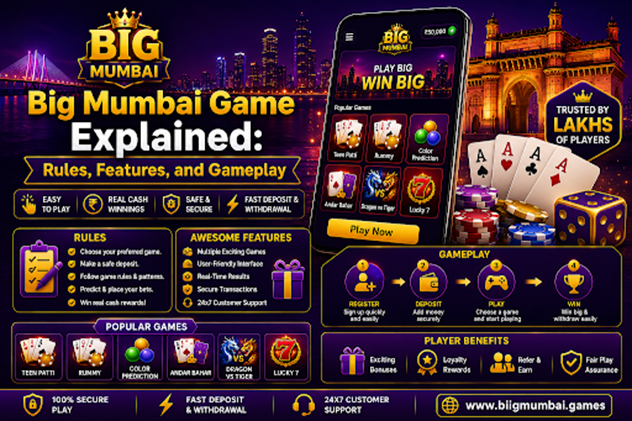
Getting started with Big Mumbai Game is easier when you understand what the platform is, how prediction-style rounds work, and what to check before you create an account. This Big Mumbai Game: Easy Guide to Getting Started walks you through the basics in plain language, with a strong focus on safety, responsible play, and practical first steps. Big Mumbai is commonly described online as a color prediction or reward-based gaming platform, so beginners should treat it as entertainment and review all legal, age, and platform rules before participating.
Big Mumbai Game is generally presented as an online gaming platform where users participate in quick prediction-style activities, often involving colors, numbers, or simple result-based rounds. The appeal is its straightforward format: users learn the round rules, make a prediction, and see the outcome after the round ends. Because some sources describe real rewards or wallet-based play, it is important to approach the platform carefully, only play where it is legal, and avoid treating any game of chance as a reliable way to earn money.
For a new user, the best mindset is simple: understand before you act. Do not rush into deposits, bonuses, or high-risk play just because the interface looks easy. A simple game can still involve financial risk, and responsible decision-making matters more than speed.
Before you explore any online prediction game, decide why you are using it. If your goal is casual entertainment, set boundaries that support that goal. If your goal is profit, pause and reconsider; prediction-based games can be unpredictable, and no guide can guarantee results.
A practical beginner mindset includes three habits. First, read the rules of each game mode instead of assuming all rounds work the same way. Second, start small if you choose to participate financially, and only use money you can afford to lose. Third, keep records of deposits, withdrawals, wins, losses, and time spent, because tracking makes it harder to ignore patterns.
This approach may sound cautious, but it protects the experience. The more clearly you understand your limits, the less likely you are to make emotional decisions after a win, a loss, or a near miss.
You get started by verifying that the platform is accessible and legal for your location, creating an account only through a source you trust, reviewing the rules, securing your login, and testing the interface carefully before taking any bigger action. Treat the first session as orientation, not competition. Your goal is to learn how the dashboard, game rounds, wallet area, and account settings work.
Use this simple beginner checklist:
These steps slow the process down in a useful way. A smooth start is not about acting quickly; it is about reducing confusion and avoiding preventable mistakes.
Online gaming accounts can contain personal details, transaction records, and wallet information, so basic security is not optional. Use a strong password that you do not use anywhere else. If two-factor authentication is available, turn it on, because it adds another layer of protection if your password is exposed.
Be cautious with links shared through social media, messaging apps, or comments. Many gaming-related searches lead to pages that look similar, and not every page claiming to represent a platform is necessarily reliable. When in doubt, stop, verify, and avoid entering login or payment details.
Good safety habits include:
Security is part of the game experience. If you cannot confidently protect your account, it is better to wait than to proceed.
Prediction games often look simple, but every round can have its own timing, conditions, payout structure, and result process. Read the instructions for the specific mode you want to try. Pay attention to when entries close, how results are shown, whether there are fees, and what happens if a connection drops.
Beginners often make mistakes because they focus only on the next result. A better approach is to understand the full flow: choose a round, review the options, confirm the entry, wait for settlement, and check the transaction record. If any part of that flow is unclear, do not increase your activity until you understand it.
It also helps to avoid myths. Past results do not guarantee future outcomes, and a short winning streak does not prove a system works. Keep your decisions grounded, especially when the game feels fast-paced.
New players should avoid rushing into deposits, chasing losses, trusting unofficial advice, ignoring the rules, or playing without limits. The biggest beginner mistake is treating a prediction platform like a guaranteed income source instead of a risk-based entertainment activity. If you feel pressure to recover money quickly or increase stakes after a loss, take a break immediately.
Watch for these warning signs:
If any of these apply, stop using the platform and consider speaking with someone you trust. Responsible play means knowing when not to play.
Keep your first session simple. Explore the dashboard, read the terms, and learn the layout before making decisions that involve money. If you decide to participate, choose the smallest possible commitment and treat it as a test of the process, not a serious strategy.
You can also create a personal rule set before you begin. For example, decide your maximum session time, maximum spend, and stop point after either wins or losses. Write those limits down. A written plan is easier to follow than a promise made in the moment.
Finally, review your activity after each session. Ask whether the experience stayed fun, whether you followed your limits, and whether anything felt unclear or unsafe. If the answer is no, adjust before returning.
If you searched for “big mumbai game: easy guide to getting started,” the most important takeaway is to begin slowly, verify everything, and prioritize safety over speed. Learn the rules, protect your account, set firm limits, and never assume that a simple prediction format removes risk. Big Mumbai Game may be easy to understand on the surface, but a responsible start is what makes the experience more controlled, practical, and informed.